Retirement mistakes rarely happen all at once.
Over the years, after helping hundreds of Canadians transition into retirement, I’ve noticed the same patterns appear again and again. More often, retirement mistakes develop slowly through a series of small, disconnected decisions that quietly compound over time.
In many cases, the people making those decisions have actually done an excellent job of saving and investing. They may already have an advisor, a strong portfolio, and a healthy net worth. Yet despite that, retirement still feels uncertain.
Questions begin to surface around whether income is being drawn from the right accounts, whether unnecessary tax is being paid, how CPP and OAS should fit into the overall strategy, or how the plan would hold up if markets struggled early in retirement.
What makes this difficult is that retirement is fundamentally different from the accumulation years. During your working life, the focus is typically on saving, investing, and growing assets. Once the paycheque stops, the challenge shifts toward coordinating withdrawals, taxes, government benefits, and long-term income planning in a way that continues to work year after year.
Most Canadians were never shown how those moving parts are supposed to work together. That’s why many retirement mistakes are not caused by one major decision, but by a lack of coordination between several smaller ones over time.
The Retirement Mistakes That Don’t Start With Investments
When people feel uneasy about retirement, they often focus on investments first. They wonder whether their portfolio is conservative enough, whether they should reduce stock exposure, or whether they should change strategies entirely.
Investments certainly matter, but most retirement mistakes do not actually begin there.
What I see far more often are retirees with reasonable portfolios, appropriate risk levels, and more than enough assets, but very little coordination between withdrawals, taxes, government benefits, and long-term income planning.
The investments themselves may be completely fine. What is missing is a clear understanding of where income is coming from each year, which accounts should be used first, how taxes evolve over time, and how each decision affects the next.
Without that coordination, retirement can still feel fragile even when the numbers appear strong on paper.
This becomes especially important for early retirees. If someone retires before CPP or OAS begins, there is often a period where taxable income becomes unusually flexible. Those years can create significant planning opportunities, but only if they are used intentionally.
When people do not fully understand how all these pieces connect, they often react emotionally instead of strategically. Some become more conservative than necessary, while others stop spending almost entirely. Not because the plan is failing, but because they do not fully understand how the plan works.
Once someone can see their retirement income year by year, including where money is coming from, how taxes change, and how different scenarios are handled, the anxiety usually begins to fade. Not because returns suddenly improved, but because uncertainty was replaced with clarity.
The Early Retirement Tax Window Most Canadians Miss
One of the biggest retirement mistakes I see has nothing to do with markets. It has to do with taxes.
When someone retires early, especially before age 65, they often enter a period they have never experienced before in adult life. Employment income disappears, but assets remain. CPP may not have started yet, OAS may still be years away, and RRIF withdrawals may not have begun.
This creates a temporary period where taxable income becomes unusually flexible.
I often refer to this as a retirement tax window, and many Canadians miss it entirely.
Instead of using those lower-income years intentionally, many people continue carrying their working-life habits into retirement. They avoid touching their RRSPs, defer income as long as possible, and preserve low taxable income without realizing they may be creating much larger tax problems later.
Years later, CPP begins, OAS begins, and mandatory RRIF withdrawals start increasing. Suddenly taxable income becomes far higher than expected, which can create larger marginal tax rates and OAS clawbacks.
The problem is that by the time this happens, much of the flexibility is already gone.
This is why retirement income planning often requires more coordination than the accumulation years. In some situations, drawing additional RRSP income earlier, while tax rates are lower, can actually reduce lifetime tax and create a much smoother income plan over time.
The goal is not to avoid tax forever. The goal is to manage taxes intentionally across the full retirement timeline.
Why CPP and OAS Decisions Are Bigger Than Most People Realize
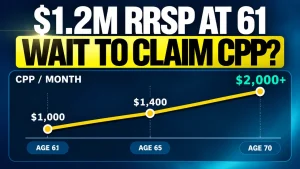
One of the most common questions Canadians ask approaching retirement is when they should start CPP.
Almost immediately, the conversation usually turns into a break-even calculation. People want to know how long they need to live for delaying CPP to “pay off” or whether taking it earlier creates a better return.
Those are understandable questions, but they often miss the bigger picture.
For many retirees, CPP is not simply about maximizing dollars. It is about creating a stronger and more stable income floor later in life.
CPP is guaranteed, indexed to inflation, and designed to last for life. That combination becomes increasingly valuable the longer retirement lasts.
For higher-net-worth retirees, CPP often plays a stabilizing role within the broader retirement income strategy. A larger CPP benefit later can reduce pressure on the portfolio, improve income stability, and provide more confidence during market volatility.
The key point is that CPP is one of many decisions. The retirement mistake is treating it as if it exists in isolation. CPP directly interacts with RRSP withdrawals, future RRIF income, OAS eligibility, tax brackets, and long-term income coordination.
Sometimes taking CPP early makes sense. In other situations, delaying CPP creates far greater long-term stability. The correct answer depends on how the entire retirement plan fits together.
One of the Most Common Retirement Mistakes With RRIFs
Another common retirement mistake is treating RRIF minimums as a retirement strategy.
They are not.
RRIF minimums are simply government rules that determine the least amount you must withdraw each year. They say nothing about tax efficiency or whether that withdrawal amount actually makes sense for your situation.
What often happens is that retirees spend the early years of retirement avoiding RRSP withdrawals altogether. They rely on cash or non-registered assets instead because it feels conservative and safe.
Years later, however, those RRSP balances are still very large. Once RRIF withdrawals begin and CPP and OAS are added on top, taxable income can rise very quickly.
At that point, withdrawals are no longer flexible. They become forced.
This is where many retirees begin encountering unexpectedly high taxes and OAS clawbacks.
Strong retirement income planning approaches withdrawals proactively rather than reactively. Instead of asking what the minimum withdrawal needs to be, the better question is what withdrawal strategy creates the best long-term outcome across taxes, benefits, and future income planning.
Sometimes that means intentionally withdrawing more earlier while tax rates remain lower.
One of the Most Overlooked Retirement Mistakes
One of the most misunderstood parts of retirement is spending.
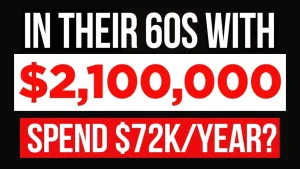
Many people assume that once retirement arrives, spending money will finally feel easy. In reality, many financially secure retirees still struggle to spend comfortably.
That hesitation usually has very little to do with net worth.
For decades, people were rewarded for saving, delaying gratification, and accumulating assets. Over time, those habits become deeply tied to identity.
Then retirement arrives, and the financial plan suddenly says it is time to start spending.
Intellectually, people understand that shift. Emotionally, it is often much harder.
I’ve worked with many retirees who clearly had enough assets to support their lifestyle, yet they still delayed meaningful experiences, travel, renovations, or personal goals. Not because they could not afford them, but because they were afraid of making the wrong decision.
This is where detailed retirement income planning becomes extremely valuable. When someone understands where income is coming from, how taxes evolve over time, and how later years are protected, spending begins to feel intentional instead of reckless.
That clarity gives people permission to actually use the money they spent decades building.
Sequence Risk Is Really an Income Planning Problem
Sequence of returns risk sounds technical, but the underlying concept is fairly simple.
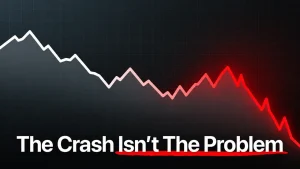
A major market decline early in retirement can create significantly more damage than the exact same decline later. Not because markets behave differently, but because withdrawals are happening at the same time.
This becomes especially dangerous when retirees are forced to sell investments during downturns to fund their lifestyle.
But sequence risk is not really a market problem. It is an income planning problem.
The strongest retirement plans prepare for volatility ahead of time by coordinating withdrawals, maintaining flexibility, and ensuring income can continue without forcing emotional decisions during difficult markets.
When retirees understand exactly how income will be funded during downturns, their behaviour changes dramatically. They stop reacting emotionally to short-term market movements and become far more confident sticking to the plan.
In retirement, behaviour is often more important than prediction.
The Best Retirement Plans Create Clarity, Not Just Projections
If there is one lesson that ties everything together, it is this:
People do not gain confidence from projections alone. They gain confidence from clarity.
Most retirement plans focus heavily on projections, probability charts, and long-term outcomes. The problem is that those tools often fail to answer the questions retirees actually care about in real life.
People want to know where income is coming from each year, how taxes will evolve, what happens if markets struggle, and how the plan adapts when life changes.
When those questions are answered clearly, behaviour changes.
People stop second-guessing every decision. Spending becomes more intentional. Tax planning becomes proactive instead of reactive. Market volatility becomes far more manageable.
That is the real difference between simply being “on track” and being prepared for retirement.
Prepared means understanding how the decisions connect year by year once work stops.
After helping hundreds of Canadians transition into retirement, I’ve found that this is the common thread that helps avoid retirement mistakes.
Not perfection.
Not prediction.
Clarity.