Should you take CPP at 60, wait until 65, or delay it until 70?
Ask that question online, and you’ll find strong opinions in every direction.
“Take it as soon as you can. You don’t know how long you’ll live.”
“Wait until 70. The payment is much bigger.”
“Take it early and invest the money.”
Each argument can make sense.
And each can be wrong.
The problem is that CPP is often treated like a decision that exists on its own.
It doesn’t.
When you take CPP, it can affect how much you withdraw from your RRSP, the taxes you pay, the government benefits you receive, how much guaranteed income you have later in life, and how you use your savings throughout retirement.
So the real question isn’t simply:
What is the best age to take CPP?
It’s:
When should you take CPP based on the rest of your retirement plan?
That’s what we’re going to answer.
What Happens If You Take CPP at 60, 65 or 70?
The standard age to start CPP is 65, but you can begin as early as 60 or delay until 70.
If you start before 65, your CPP is reduced by 0.6% for every month you take it early.
Start at 60 and your payment is 36% lower than it would have been at 65.
If you delay beyond 65, the opposite happens. Your CPP increases by 0.7% for every month you wait.
Delay until 70 and your payment is 42% higher than it would have been at 65.
There is no additional increase for waiting beyond 70.
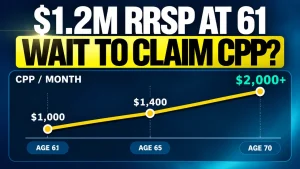
So if your CPP at 65 were $1,000 per month, a simplified comparison would look like this:
| CPP Start Age | Adjustment | Monthly CPP |
|---|---|---|
| 60 | -36% | $640 |
| 65 | — | $1,000 |
| 70 | +42% | $1,420 |
The actual amount you receive will depend on your contribution history and other factors, but the trade-off is clear:
Take CPP earlier and receive smaller payments for longer. Delay CPP and receive larger payments for fewer years.
That leads to one of the most common ways Canadians try to solve the decision.
The CPP break-even age.
What Is the CPP Break-Even Age?
A break-even calculation asks when the larger CPP payments from delaying finally make up for the payments you gave up while waiting.
For example, when comparing CPP at 65 with CPP at 70, you’ll commonly see a break-even point somewhere in your early 80s.
That leads to a seemingly simple decision:
Expect to live beyond the break-even age? Delay CPP.
Don’t expect to? Take it earlier.
The calculation isn’t useless.
But it leaves out a very important question:
What are you living on while you wait?
Suppose you retire at 65 and delay CPP until 70.
You still need money for groceries.
You still have property taxes.
You might want to travel.
Life doesn’t stop for five years while you wait for CPP.
That money has to come from somewhere.
Maybe it comes from your RRSP.
Now you’re no longer comparing CPP at 65 with CPP at 70.
You’re comparing:
Take CPP at 65 and withdraw less from your RRSP
with:
Delay CPP until 70 and withdraw more from your RRSP first.
Those two strategies can produce different taxes, different RRSP balances and different amounts of taxable income later in retirement.
That’s why the break-even age is only one piece of the decision.
When Does Taking CPP at 60 Make Sense?
There is nothing inherently wrong with taking CPP at 60.
For some people, it’s the right decision.
Here are some situations where starting early is worth considering.
1. You need the income
Sometimes this decision doesn’t need to be complicated.
You retire at 60.
Your paycheque stops.
But the bills don’t.
CPP can provide dependable monthly income and reduce how much you need to withdraw from your investments.
Yes, you’re accepting a smaller CPP payment for life.
But maximizing CPP isn’t necessarily the objective.
Your retirement income needs to support your retirement.
If receiving CPP earlier allows you to do that, there may be a good reason to start.
2. Your health or life expectancy is a concern
The longer you live, the more valuable a larger lifetime CPP payment can become.
The opposite is also true.
If your health, family history or personal circumstances suggest a shorter-than-average life expectancy, waiting years for a larger payment may be less attractive.
Nobody knows exactly how long they’ll live.
But ignoring what you know about your health doesn’t make the decision more objective.
It simply removes useful information from it.
3. CPP can help bridge an early retirement
Imagine you stop working at 60.
OAS can’t begin yet. Perhaps your workplace pension doesn’t begin immediately either.
That creates a gap.
CPP can be used as one source of income to bridge those early retirement years and reduce the amount you need from your portfolio.
But there’s an important question to ask before doing this:
Is reducing portfolio withdrawals actually what you want?
Because those same years might create an opportunity to deliberately withdraw money from your RRSP.
We’ll come back to that.
4. You value guaranteed income today
CPP and an investment account do different jobs.
Your investments can rise and fall with the market.
CPP provides monthly lifetime income and, once you’re receiving it, is adjusted annually with inflation.
For some retirees, having more dependable income early makes it easier to spend from the rest of their portfolio.
That has value.
5. Your taxable income could be much higher later
It’s easy to assume your taxes will go down after you retire.
That isn’t always what happens.
Imagine someone retires in their early 60s.
Their employment income disappears, creating several relatively low-income years.
Later, CPP starts.
Then OAS.
Eventually, their RRSP becomes a RRIF and mandatory withdrawals begin.
Add a pension or investment income and suddenly their taxable income at 72 could be considerably higher than it was at 62.
In some situations, starting a smaller CPP earlier can help spread taxable income across more years rather than adding an even larger CPP payment to an already high-income period.
The important words are in some situations.
Because for another retiree, doing almost the exact opposite may produce the better result.
When Does Delaying CPP Make Sense?
Now let’s flip the decision.
There are several situations where giving up CPP today in exchange for a larger payment later can be attractive.
1. You’re still working and don’t need the money
Suppose you’re 62, earning a good salary and already have enough income to support your lifestyle.
Starting CPP creates another source of taxable income.
You don’t actually need it.
And you’re permanently reducing the base CPP pension you could receive by waiting.
If you continue working while receiving CPP before 65, you generally continue making CPP contributions and can earn Post-Retirement Benefits. From 65 to 70, continued contributions can be optional.
Those additional benefits have value.
But they don’t erase the original early-start reduction.
So if you’re still working and don’t need CPP, it’s worth asking:
Why am I starting it now?
2. You want more guaranteed income later in life
Think about your financial life at 60.
You may still be working.
You probably have more flexibility.
You have a portfolio you can draw from.
Now picture yourself at 85.
You may want less responsibility for managing investments. Your ability to change course could be lower, and you’ve had another 25 years to spend your savings.
A larger CPP payment can be particularly valuable then.
This is one reason CPP is sometimes thought of as a form of longevity protection.
You’re giving up income during years when you may have more financial flexibility in exchange for more guaranteed income during years when you may have less.
3. You can use your RRSP first
This is where the CPP decision becomes much more interesting.
Suppose you’re 60 with a sizable RRSP.
You retire.
Instead of starting CPP immediately, you use some of your RRSP to fund your lifestyle.
At first, voluntarily withdrawing taxable RRSP money might sound backwards.
Why create a tax bill when you could take CPP instead?
Because your objective shouldn’t necessarily be to pay the least amount of tax this year.
It should be to look at the taxes you may pay over your retirement.
If you leave your RRSP untouched, it can continue growing.
Eventually, it must be converted to a RRIF, and minimum withdrawals begin.
Now those withdrawals could be arriving alongside CPP, OAS, a pension and other taxable income.
By withdrawing some RRSP money earlier, you may be able to use lower tax brackets, reduce the future size of the account and create smaller mandatory withdrawals later.
That can also help reduce the possibility of your future income affecting OAS.
So delaying CPP isn’t always about getting more CPP.
Sometimes it’s about what delaying CPP allows you to do with everything else.
Should You Take CPP Early and Invest It?
This sounds like one of the strongest arguments for taking CPP early.
Why wait for a bigger CPP payment if you can take the money at 60, invest it yourself and let it compound?
It’s certainly possible to come out ahead.
But the comparison is often oversimplified.
Someone might assume:
“I’ll earn 9% or 10% on the money.”
But markets don’t return 9% every year.
Some years will be much better.
Others will be negative.
And there are three questions worth asking.
First, what return are you realistically expecting?
Taking CPP early to invest aggressively is very different from taking CPP early and putting it into a low-return savings product.
Second, will you actually invest every payment?
It’s easy to say you’ll invest CPP for the next ten years.
It’s harder to do it every month without eventually using some of the money.
Third, what are you giving up?
You’re not simply comparing one investment return with another.
You’re exchanging some future guaranteed, inflation-adjusted lifetime income for money you can invest today.
Those aren’t the same thing.
So instead of asking:
“Can I earn more by investing my CPP?”
Ask:
“Do I want CPP to provide more guaranteed income later, or do I want more money under my control today?”
That’s a much more useful comparison.
Your CPP Estimate May Be Wrong for Your Retirement Plan
Before deciding when to take CPP, you need a reasonable estimate of how much you’ll receive.
Your My Service Canada Account is a useful place to start.
But don’t look at a CPP estimate and automatically assume that is exactly what you’ll receive.
Your actual CPP is affected by your earnings and contribution history.
That matters particularly if you’re planning to retire early or reduce your hours before 65.
Consider two 60-year-olds who have identical contribution histories today.
One plans to work full-time until 65.
The other retires tomorrow.
Their future contribution histories are now different.
That can affect their eventual CPP.
A better starting point is to review your actual CPP Statement of Contributions and understand what assumptions are being made about your future earnings.
What If You Retire Before Taking CPP?
This creates another common concern.
Suppose you retire at 60 but want to delay CPP until 70.
Does that mean ten years of zero earnings will destroy your CPP calculation?
Not necessarily.
CPP contains provisions designed to account for periods of low or no earnings.
For the base CPP calculation, up to eight years of your lowest earnings can generally be excluded. The enhanced portion of CPP uses your best 40 years of earnings.
There are also separate provisions that can apply to periods when you were raising young children or receiving CPP disability benefits.
That means stopping work and delaying CPP isn’t automatically a bad combination.
But the result depends on your actual contribution history.
This is something worth calculating rather than guessing.
One CPP Rule Most Canadians Don’t Know About
There’s another detail happening underneath your CPP calculation that helps explain why delaying can be more valuable than people realize.
Before you start CPP, the calculations behind your future benefit are tied partly to Canadian pensionable earnings limits, which change as wages across Canada change.
Once you begin receiving CPP, your pension is instead adjusted annually based on the Consumer Price Index.
In other words, CPP before you start it and CPP after you start it aren’t adjusted in exactly the same way.
This doesn’t mean delaying CPP is automatically better.
Far from it.
Your health, taxes, income needs and other assets can matter much more.
But it does help explain why the CPP amount available to you at a later age isn’t simply today’s benefit plus the well-known deferral increase.
There is more happening underneath the calculation.
How CPP Can Affect Your Taxes and OAS
CPP is taxable income.
So are RRSP and RRIF withdrawals.
OAS is also taxable, and higher income can eventually cause some or all of your OAS to be repaid through the OAS recovery tax.
This creates an important planning problem.
Imagine someone reaches their 70s with:
- a large RRIF,
- CPP,
- OAS,
- a workplace pension, and
- investment income.
Each source looks manageable by itself.
Put them together and the tax picture can change considerably.
This is why looking only at the size of your CPP payment can lead you in the wrong direction.
A larger CPP payment is good.
But where does that larger payment land in your tax plan?
If delaying CPP also allowed you to strategically reduce a large RRSP during your 60s, the answer might be very favourable.
If it simply creates even more taxable income during your highest-income retirement years, the result could be different.
The objective is not to maximize CPP.
It’s not even necessarily to minimize tax.
It’s to coordinate the pieces so they work together.
What About GIS?
If you expect to qualify for the Guaranteed Income Supplement, CPP timing requires another layer of analysis.
GIS is income-tested.
CPP counts as income when GIS eligibility is calculated.
So a larger CPP benefit can reduce the amount of GIS someone receives.
That means looking only at CPP could give you the wrong answer.
What matters is what happens to your total income after CPP, OAS and GIS are considered together.
For lower-income retirees, that interaction can matter far more than a traditional CPP break-even calculation.
Married? Don’t Make Your CPP Decision Alone
CPP is an individual benefit.
Retirement usually isn’t.
A couple has one household to fund, and the two CPP decisions should be considered together.
For example, it may make sense for one spouse to start CPP earlier while the other delays.
That could provide some guaranteed income today while increasing the other spouse’s individual CPP later.
Or both spouses might start early.
Or both might delay.
There is no universal combination.
Health, age differences, CPP entitlements, pensions, investments, taxes and spending needs can all affect the answer.
CPP survivor benefits should also be considered, but don’t assume a surviving spouse simply keeps both CPP payments. Survivor benefits have their own calculation and combined-benefit limits.
The bigger idea is simple:
Don’t make two individual CPP decisions while ignoring the one retirement plan they’re supposed to fund.
So, When Should You Take CPP?
There is no age that’s best for everyone.
But there is a much better way to make the decision.
Before starting CPP, answer these questions:
- Do you actually need the income today?
- If you delay CPP, where will your income come from instead?
- Could you use those years to strategically withdraw money from your RRSP?
- What will your taxable income look like in your 60s, 70s and 80s?
- Could your future income affect OAS or GIS?
- Are you still working?
- How is your health, and what does longevity look like in your family?
- How much guaranteed income do you want later in life?
- If you’re married, how does your decision work with your spouse’s?
- Most importantly, what do you want your money to allow you to do?
That last question gets missed surprisingly often.
Maybe mathematically delaying CPP produces the highest lifetime income.
But what if you’d rather have more money available between 60 and 70, when you’re healthy, travelling and doing the things you’ve spent decades waiting to do?
That’s not necessarily a financial mistake.
Money at 62 and money at 82 aren’t always worth the same thing to you.
A good retirement plan should recognize that.
The Biggest CPP Mistake Isn’t Taking It at 60
And it isn’t waiting until 70.
It’s making the decision in isolation.
Your CPP affects how much you need from your investments.
Your investment withdrawals affect your taxes.
Your RRSP withdrawals today affect your RRIF withdrawals tomorrow.
Your taxable income can affect OAS and GIS.
And the amount of guaranteed income you create later can change how much flexibility you have as you age.
They’re all connected.
That’s why two Canadians who are the same age with similar CPP benefits can reasonably make completely different decisions.
One might be better off starting CPP at 60.
Another might be better off waiting until 70.
The goal isn’t to find the best age to take CPP.
It’s to find the age that makes the rest of your retirement plan work better.